

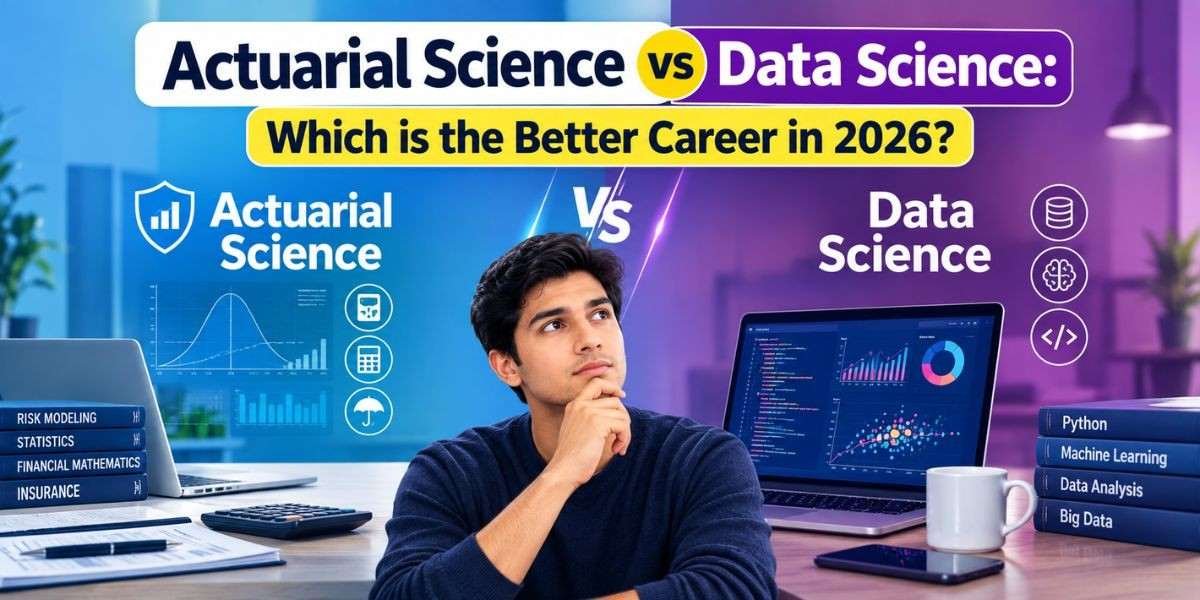
Choosing between two strong analytical careers is not always easy. If you enjoy mathematics, statistics and problem-solving, choosing between actuarial science and data science can be a difficult career decision. For students considering actuarial education, structured coaching can help build the fundamentals needed for the actuarial examination pathway, while data science usually requires a different combination of programming, statistics and machine learning skills.
Both fields work with numbers, models and uncertainty. The difference lies in what you do with them.
An actuary focuses heavily on risk, financial consequences and long-term uncertainty. A data scientist uses data, statistical modelling and computational methods to find patterns, make predictions and support decisions.
So, which is the better career in 2026?
The honest answer is: it depends on your strengths, career goals and the kind of work you actually enjoy.
Actuarial Science vs Data Science: What Is the Difference?
Before comparing salaries, career growth or job opportunities, it helps to understand what each profession actually does. The two fields overlap in mathematics and statistics, but their problems, tools and professional pathways differ.
What Does an Actuary Do?
An actuary evaluates financial risk using mathematics, probability, statistics and business knowledge. Actuaries commonly work in insurance, pensions, investments, banking, consulting and enterprise risk management.
The Society of Actuaries describes actuaries as professionals who analyse risk and combine mathematics, human behaviour and business realities when assessing uncertain outcomes. Its career pathways include areas such as pricing, valuation, investments, enterprise risk management, predictive analytics and financial services.
In India, the Institute of Actuaries of India (IAI) regulates the actuarial profession under the Actuaries Act, 2006. Its current qualification structure includes Core Principles and Core Applications subjects, followed by further examinations and experience requirements for Fellowship.
In simple terms, an actuary asks:
“What could happen, how likely is it, and what could it cost?”
That question is incredibly useful when an organisation needs to price risk or prepare for uncertain financial outcomes.
What Does a Data Scientist Do?
A data scientist works with large or complex datasets to extract useful information and support business or technical decisions.
According to the U.S. Bureau of Labor Statistics, data scientists collect, categorise and analyse data, develop and test algorithms and models, and use data visualisation to communicate findings.
A data scientist might ask:
What does the data tell us, what is likely to happen next, and how can we use that information?
That work can involve Python, SQL, statistical analysis, machine learning, data visualisation and predictive modelling.
So although both careers use mathematics and statistics, data science generally places much more emphasis on programming and computational tools.
Actuary vs Data Scientist in India: Career Path and Qualification
For an actuary vs data scientist India comparison, the education and qualification routes are among the biggest differences.
Actuarial Career Path
The actuarial profession has a structured professional examination pathway.
The IAI provides admission routes through ACET as well as specified non-ACET routes, subject to its current eligibility requirements. Students should check the Institute’s latest admission criteria before choosing their route.
IAI provides progression from student membership toward Associate and Fellow status. For Fellowship, the Institute’s current requirements include completion of the prescribed examinations, the India Fellowship Seminar and at least three years of relevant actuarial experience, subject to its applicable rules.
That makes actuarial science a professional qualification journey rather than simply a degree followed by job applications.
Data Science Career Path
Data science has a more varied entry route.
A candidate may enter through computer science, mathematics, statistics, engineering, economics or another quantitative discipline and then develop practical data skills. Some employers may prefer advanced degrees for particular positions.
The U.S. Bureau of Labor Statistics states that data scientists typically need at least a bachelor’s degree in mathematics, statistics, computer science or a related field, while some employers prefer a master’s or doctoral degree.
There is therefore no single universal data-science qualification comparable to the actuarial examination pathway.
That flexibility can be an advantage, but it also means candidates need to build a convincing combination of technical and analytical skills.
Skills You Need in Each Career
A career comparison becomes much more useful when we stop asking which field is better and ask which field fits your abilities.
Skills for Actuarial Science
Actuarial mathematics, probability and statistics form the foundation.
You also need:
- Strong numerical reasoning
- Statistical modelling
- Financial modelling
- Risk analysis
- Problem-solving ability
- Business understanding
- Attention to detail
- Communication skills
- Persistence with professional examinations
The work can become highly specialised. Depending on the role, an actuarial professional may work on pricing, reserving, pensions, investments, financial risk analysis or enterprise risk management.
The Society of Actuaries lists career applications across banking and financial services, consulting, enterprise risk management, investments, pensions, pricing, reinsurance, predictive analytics and valuation.
Skills for Data Science
Data science requires a different technical toolkit.
Important skills include:
- Statistics and probability
- Python or another programming language
- SQL
- Data cleaning
- Data visualisation
- Machine learning
- Predictive analytics
- Statistical modelling
- Business analytics
- Communication
- Problem-solving
The BLS identifies mathematics, computers and information technology, and writing and reading among the leading skill areas for data scientists.
If writing code sounds like an interesting puzzle rather than a punishment, data science may feel more natural.
If you enjoy mathematical reasoning, financial uncertainty and structured professional examinations, actuarial science may suit you better.
Actuarial Science vs Data Science: Career Opportunities
Both fields offer meaningful career opportunities, but their industries differ.
Actuarial Career Opportunities
Actuarial career opportunities traditionally centre around insurance and pensions, but the profession extends beyond those areas.
Actuaries can work in:
- Insurance
- Reinsurance
- Consulting
- Banking
- Investments
- Pension and retirement planning
- Enterprise risk management
- Financial services
- Predictive analytics
This wider range is reflected in the career areas published by the Society of Actuaries.
Actuarial work also increasingly intersects with analytics. The Society of Actuaries, for example, lists predictive analytics among actuarial practice areas, alongside pricing, valuation, investments and enterprise risk management.
Data Science Career Opportunities
Data science has a broader presence across technology and business.
Data science career opportunities can exist in:
- Technology
- Banking and fintech
- Healthcare
- Retail
- Consulting
- Marketing
- Manufacturing
- Financial services
- Telecommunications
- Artificial intelligence
That distinction matters. A statistic from the United States does not magically become an Indian statistic because someone put India in the heading.
Which Career Has Better Future Scope in 2026?
The future of both fields looks closely connected to the increasing importance of data and analytical decision-making.
The World Economic Forum’s Future of Jobs Report 2025 identifies AI and big data among the fastest-growing skill areas through 2030. It also says analytical thinking remains the top core skill identified by employers, with seven in ten companies considering it essential.
This is important for both professions.
Data scientists directly work with AI, big data, machine learning and predictive analytics.
Actuaries also operate in a data-heavy profession where statistical modelling, risk analysis and predictive methods matter. The WEF’s research specifically lists insurance and pensions management among industries where AI and big-data skills are expected to grow in importance.
Therefore, the future is not simply:
Actuarial science vs data science = old career vs new career.
It is more accurate to think of them as two analytical professions adapting to the same increasingly data-driven economy.
Salary and Earning Potential: Which Is Better?
Salary is naturally part of any career decision, but this is where online comparisons often become unreliable.
You will find websites publishing precise average salaries for actuaries and data scientists in India, but salary varies significantly by experience, employer, city, qualification level, job title and industry. A single number can create false confidence.
For Indian students, it is better to compare:
Data science career opportunities can exist in:
- Technology
- Banking and fintech
- Healthcare
- Retail
- Consulting
- Marketing
- Manufacturing
- Financial services
- Telecommunications
- Artificial intelligence
Which Career Has Better Future Scope in 2026?
The World Economic Forum’s Future of Jobs Report 2025 identifies AI and big data among the fastest-growing skill areas through 2030. It also says analytical thinking remains the top core skill identified by employers, with seven in ten companies considering it essential.
Salary and Earning Potential: Which Is Better?
You will find websites publishing precise average salaries for actuaries and data scientists in India, but salary varies significantly by experience, employer, city, qualification level, job title and industry. A single number can create false confidence.
- Qualification level
- Relevant experience
- Industry
- Technical skills
- Professional status
- Employer
- Location
- Role and responsibilities
In actuarial science, progression through professional examinations can also affect the roles a candidate becomes eligible for over time.
So if your only question is Which one pays more?, you are asking a much smaller question than the career decision actually requires.
Actuarial Science vs Data Science: Difficulty
Both careers are challenging, but the difficulty comes in different forms.
Actuarial science demands sustained preparation for professional examinations. The IAI maintains formal examination policies, pass-mark rules and student guidance, and its qualification pathway requires progression through multiple subjects and experience requirements.
Data science has a different learning curve.
You may need to learn programming, statistics, databases, machine learning, data visualisation and domain knowledge. The field also changes quickly, which means continuous learning is part of the job.
So:
Actuarial difficulty: mathematical depth + professional examinations + persistence.
Data science difficulty: mathematics + programming + technology + continuous learning.
Neither deserves the easy career label.
Which Career Offers Better Job Security?
Job security depends on far more than the job title.
A professional who stops learning can become less valuable in almost any industry.
The World Economic Forum expects significant changes in skill requirements through 2030. Its 2025 report estimates that 39% of workers’ existing skill sets could be transformed or become outdated during the 2025–2030 period. It also identifies AI, big data, technological literacy, analytical thinking and adaptability as important areas of change.
That suggests an important lesson for both careers:
Build skills that remain useful when tools change.
For actuaries, that may mean combining actuarial knowledge with analytics and technology.
For data scientists, it means maintaining strong fundamentals in statistics, programming and business problem-solving rather than relying entirely on whichever AI tool happens to be popular this month.
Actuarial Science or Data Science: Which Should You Choose?
There is no universal winner.
Choose Actuarial Science if You:
- Enjoy mathematics and probability.
- Like financial and risk-related problems.
- Prefer a structured professional qualification.
- Are comfortable with long-term examination preparation.
- Want to explore insurance, pensions, consulting or financial risk.
- Prefer analytical work with a strong business and financial context.
Choose Data Science if You:
- Enjoy programming and technology.
- Like working with large datasets.
- Want to explore machine learning and AI.
- Enjoy experimentation and predictive analytics.
- Prefer a flexible technical career path.
- Want opportunities across technology, finance, healthcare, retail and other industries.
Your career suitability matters more than whatever career happens to be trending on social media this week.
Where Does AI Fit Into This Career Comparison?
AI does not make either career automatically obsolete.
The World Economic Forum expects AI and big data to be among the fastest-growing skill areas through 2030, while analytical thinking remains a core employer requirement.
For data scientists, AI is already directly connected to the profession. Data scientists increasingly work with machine learning systems and AI-enabled workflows.
For actuaries, technology can change how professionals collect data, build models and analyse risk. But understanding assumptions, uncertainty, financial consequences and business context still requires human judgement.
That creates an interesting future: the strongest professionals may not be those who avoid AI, but those who know how to use it without outsourcing their thinking to it.
Is Actuarial Science Better Than Data Science in 2026?
If you want a single verdict, here it is:
Actuarial science is better for students who want a structured, mathematics-heavy professional career focused on risk and finance. Data science is better for students who want a technology-driven career involving programming, analytics, machine learning and broader industry applications.
Neither is objectively the better career for everyone.
For students seriously considering actuarial science, choosing the right preparation environment matters. Inflexion Point focuses on concept-driven learning, structured preparation and expert mentorship, with online and offline actuarial coaching designed to support students across India and classroom learners in Delhi.
Students looking for the Top ACET coaching institute in Delhi should evaluate teaching quality, conceptual clarity, preparation structure and whether the learning environment fits their needs rather than choosing a coaching provider simply because an advertisement says “best.”
If you are specifically searching for ACET coaching near Mukherjee Nagar, location and learning format can also matter because consistent preparation is easier when the study routine fits your schedule.
Final Verdict: Which Career Is Better?
The best career choice depends on the kind of problems you want to solve.
Choose actuarial science if you see yourself analysing uncertainty, calculating financial risk and developing expertise through a structured professional qualification.
Choose data science if you are more interested in programming, data, machine learning and technology-driven problem-solving.
And if you are still undecided, do not choose based on a salary screenshot or a “top 10 careers” video.
Look at the subjects. Look at the qualification process. Look at the daily work. Then ask yourself which one you can realistically enjoy learning for several years.
For students leaning toward actuarial science, Inflexion Point provides structured online and offline preparation focused on strong fundamentals, problem-solving and actuarial examination preparation.
The smartest answer to Actuarial science vs data science is not “this one always wins.”
It is:
Choose the career whose work, learning curve and long-term prospects match the person you want to become.